
Menu
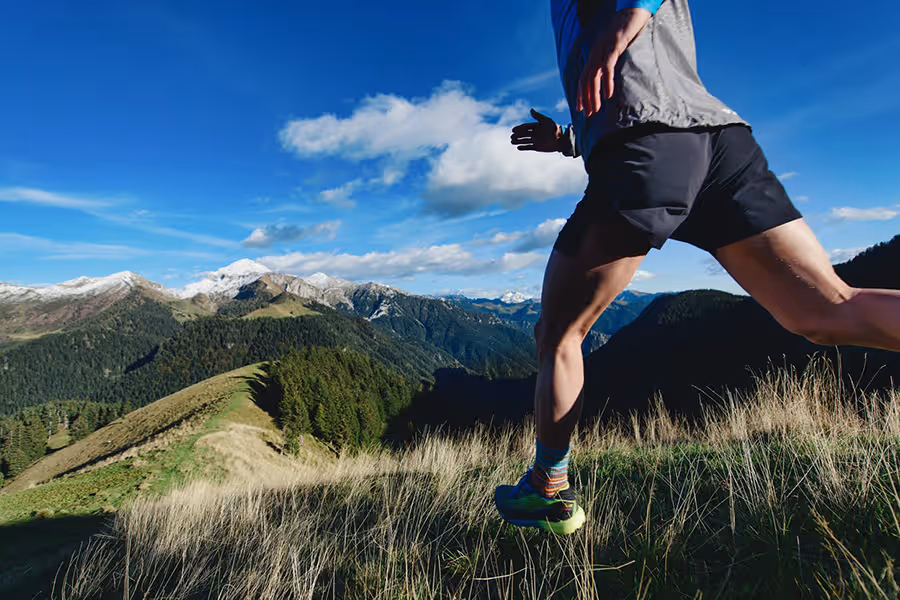
Physical activity opportunities are everywhere – choose your way
There are many scientifically proven and well-known connections between physical activity and health. Living in welfare states gives many opportunities for health and for being physically active. However, on the contrary, many wealthy people struggle to obtain physical activity levels that are adequate for their health. There are many ways to be physically active, it is only a matter of point of view.
Despite living in welfare states with access to resources that support our health and wellbeing, many of us still face health challenges such as unhealthy weight or low levels of physical activity (PA). (Santos et al. 2017; Husu et al. 2022) In welfare states, on average, incomes are good, and they correlate well with healthier lifestyles. (EAPN Europe 2025; Ryff 2024) It seems that we who are living in welfare states are not exploiting the possibilities to be physically active. Instead, we seek comfortability by commuting to work by car or by watching bit too much Netflix or other streaming services. Even though PA is one of the easiest ways to stay healthy, how would people get more physical movement in their everyday lives? How to overcome such welfare bias? Perhaps, we must approach this from different points of views – in which PA is just a side effect, not the main goal.
Physical activity benefits
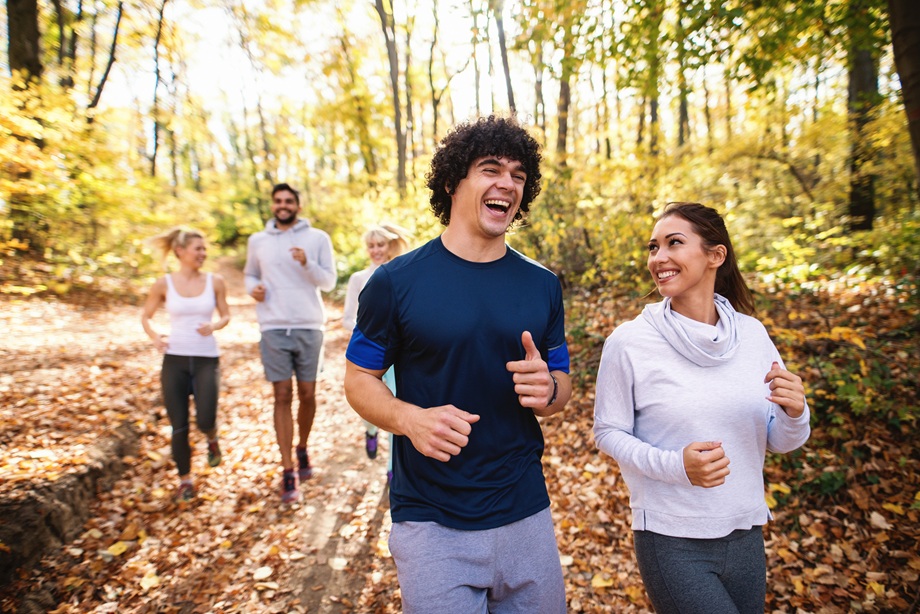
Direct health benefits of PA are undeniable. The association between PA and all-cause mortality was reaffirmed with the addition that even light intensity PA was associated with lower risk of mortality and cardiovascular diseases. (WHO 2024) There is also a large body of evidence showing PA being beneficiary with weight maintenance. (WHO 2020)
From the mental health perspective, PA can reduce anxiety and depression and improve the quality of life (WHO 2020). PA is indeed an effective tool to regulate emotions and manage stress and it also promotes mental health and well-being. (Teychenne et al. 2020; Martin-Rodriguez et al. 2024) It seems that PA is a key to health. But how much PA do we need and how do we take action?
How much is enough?
For one week, adults should do at least 150-300 minutes of moderate-intensity aerobic physical activity or at least 75 minutes of vigorous-intensity aerobic physical activity. These can be combined throughout the week to obtain health benefits. Twice a week or more, muscle-strengthening activities are strongly recommended, at moderate or greater intensity involving all major muscle groups. All PA should be regular for substantial health benefits. (WHO 2020)
When in struggle to add PA or exercise to a regular basis, it might be beneficial to look at it from a different perspective. What is PA and what exercise counts? In fact, any bodily movement produced by skeletal muscles that requires energy expenditure is PA (WHO 2024), thus, almost anything counts. To obtain the substantial health benefits, the activity should be equal to heavy breathing and breaking sweat, otherwise it is light intensity activity. Remember, light intensity activity is also beneficial for health and is always good to start with! Here are some suggestions on how to add PA to your daily life from different points of view.
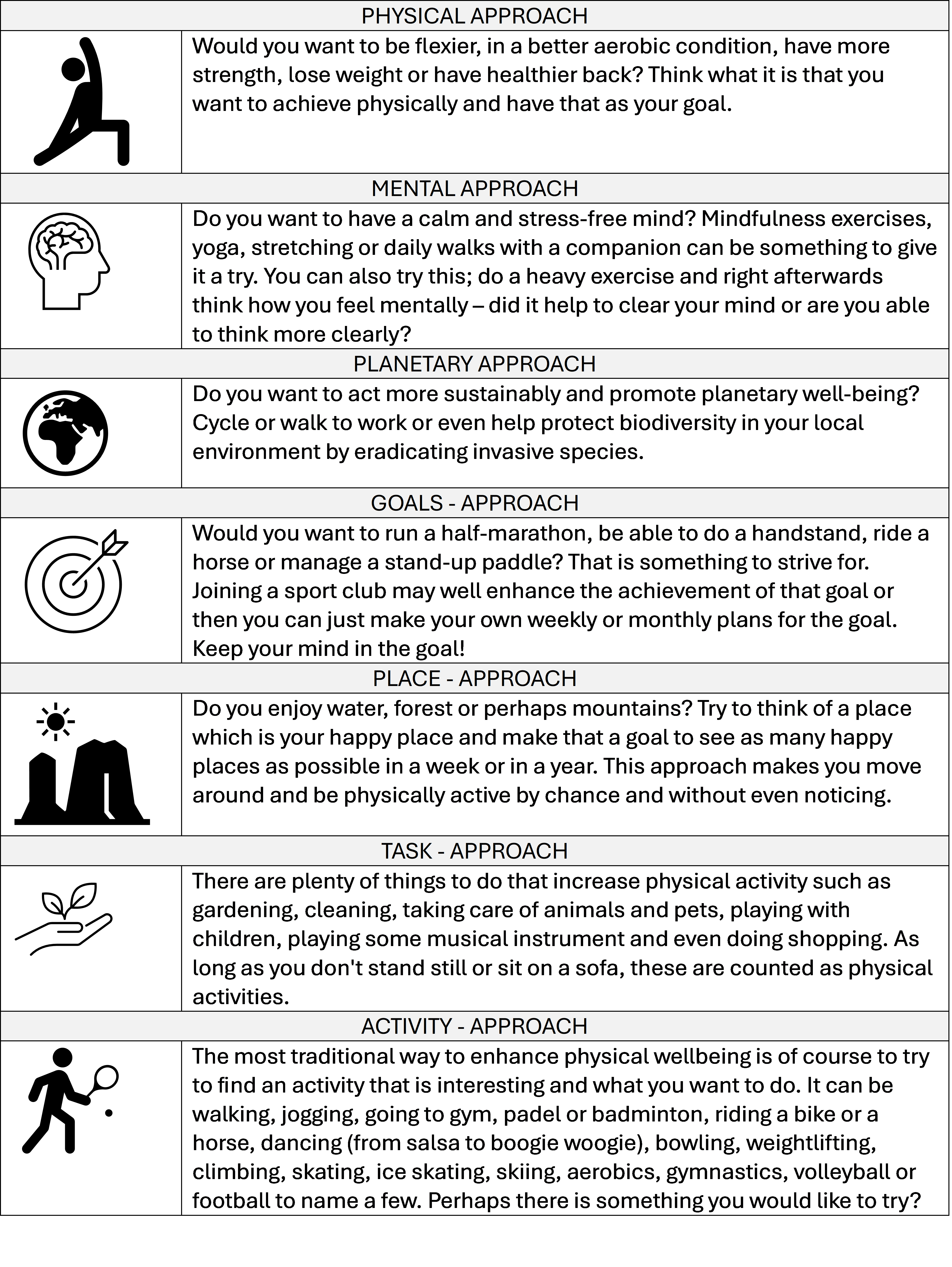
There are many ways to be physically active – just choose your way!
Physical activity can be looked at from different perspectives, not only through recommendations or from sports perspectives. (Picture 1) When choosing ways to be active that suits your everyday life, the choices are more likely to be sustainable. It also must be something that brings joy to life.
Conclusion
Taking care of physical wellbeing is taking care of your mental wellbeing as well, as they are strongly linked. Choose your approach to physical activity and go for it and most importantly, do what makes you feel good! When doing things that also suit your everyday life and gives you joy, it is a sustainable direction to your health and wellbeing – both physical and mental.
Key words: physical activity, wellbeing, approach, personal wellbeing, physical wellbeing, mental wellbeing
Sources
EAPN Europe 2025. Eurostat updated poverty and social exclusion statistics for the EU in May 2025. https://www.eapn.eu/eurostat-updated-poverty-and-social-exclusion-statistics-for-the-eu-in-may-2025/ (read 10.6.2025)
Husu P, Tokola K, Vähä-Ypyä H & Vasankari T. 2022. Liikuntaraportti. Suomalaisten mitattu liikkuminen, paikallaanolo ja fyysinen kunto 2018–2022. Opetus- ja kulttuuriministeriö Helsinki. Opetus- ja kulttuuriministeriön julkaisuja 2022:33.
Income distribution statistics [online publication]. 2025. Reference period: 2023. ISSN=1799-1331. Helsinki: Statistics Finland [Referenced: 21.5.2025]. Access method: https://stat.fi/en/publication/cln2v1lfy388b0bvzwdaz0fnw
Martín-Rodríguez A, Gostian-Ropotin LA, Beltrán-Velasco AI, Belando-Pedreño N, Simón JA, López-Mora C, Navarro-Jiménez E, Tornero-Aguilera JF, Clemente-Suárez VJ. 2024. Sporting Mind: The Interplay of Physical Activity and Psychological Health. Sports. 2024; 12(1):37. https://doi.org/10.3390/sports12010037.
Ryff CD 2024. The Privilege of Well-Being in an Increasingly Unequal Society. Current Directions in Psychological Science, 33(5), 300-307. https://doi.org/10.1177/09637214241266818 (Original work published 2024)
Santos I, Sniehotta FF, Marques MM, Carraça EV, Teixeira PJ. 2017. Prevalence of personal weight control attempts in adults: a systematic review and meta-analysis. Obes Rev. 2017 Jan;18(1):32-50. doi: 10.1111/obr.12466. Epub 2016 Sep 21. PMID: 27653242; PMCID: PMC5215364.
Teychenne M, White RL, Richards J, Schuch FB, Rosenbaum S, Bennie JA. 2020. Do we need physical activity guidelines for mental health: what does the evidence tell us? Ment Health Phys Act. 2020;18:100315.
WHO Guidelines on Physical Activity and Sedentary Behaviour. 2020. Geneva: World Health Organization; 2020. RECOMMENDATIONS. Available from: https://www.ncbi.nlm.nih.gov/books/NBK566046/ (read 30.5.2025)
WHO Fact sheet: physical activity. 26.6.2024. https://www.who.int/news-room/fact-sheets/detail/physical-activity (read 30.5.2025)
Image Source: Turku UAS Picture Bank
Authors:
Tanja Matarma, Senior Specialist, Turku University of Applied Sciences
Irina Katajisto-Korhonen, Senior Lecturer, Turku University of Applied Sciences
Publication Date: 23.10.2025


DISCLAIMER:
Co-funded by the European Union. Views and opinions expressed are however those of the author(s) only and do not necessarily reflect those of the European Union or Fundacja Rozwoju Systemu Edukacji (FRSE). Neither the European Union nor FRSE can be held responsible for them.
We love to hear from you
For information about data privacy, please check the privacy policy.