The Hidden Cost of Bright Nights: Light Pollution and the Health of Our Planet
The Bright Threat to Our Planet's Health
The Industrial Revolution of the 18th century and the succeeding industrialization processes led to an intensive migration from rural areas to cities. According to the European Commission’s “Atlas of the Human Planet 2024”, 80% of the world's people live in urbanized areas, of which 45% live in cities with 50,000 or more inhabitants, and 35% in cities with at least 5,000 inhabitants [1]. Due to intensive urbanization, the intensity of construction increases, traffic flows grow, air, water and soil pollution increases, and in the second half of 20th century astronomers and other scientists started talking about light pollution. This phenomenon, characterized by excessive, misdirected, or inappropriate artificial light at night (ALAN), not only causes loss of the views of astronomical objects (picture 1), but also poses a significant threat to the balance of our planet's ecosystems and the holistic concept of planetary well-being, which covers personal, professional, and planetary welfare. This article introduces the complex impacts of light pollution, based on the latest scientific research, and highlights actionable solutions to mitigate its adverse effects.
Picture 1. An infographic illustrating the effects of light pollution on the visibility of stars and other objects in the night sky. Photo: NOIRLab/NSF/AURA/P. Marenfeld
A Global Phenomenon
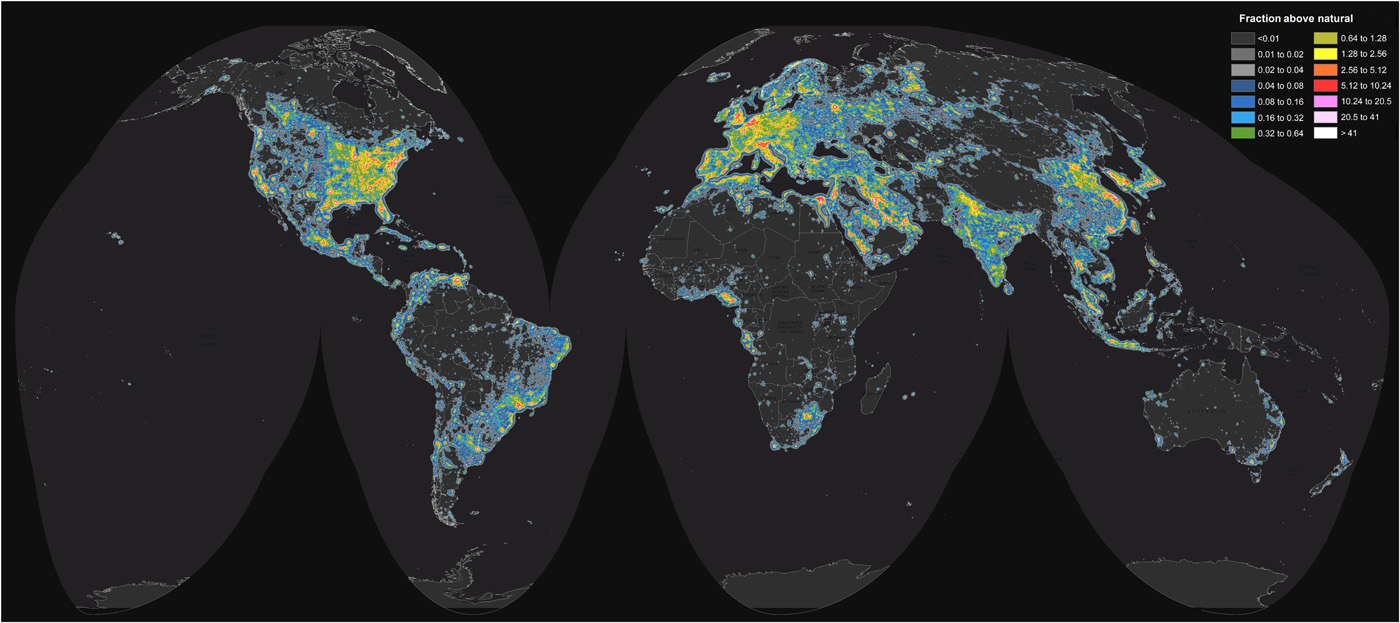
The spread of artificial light at night is a global trend with alarming consequences. Recent long-term global studies, applying satellite data, reveal 16% increase in total ALAN radiance from 2014 to 2022, indicating a continuously brightening planet [2, 3] (Picture 2). This expansion of artificial light is primarily triggered by urbanization, economic development, and the widespread adoption of energy-efficient but often poorly designed LED lighting. While intended to improve safety and productivity, this ever-growing glow leads to significant detrimental impact on human and ecological health.
Picture 2. World map of artificial sky brightness [20]
Ecological Impacts
Light pollution profoundly disrupts the natural day-night cycles that have regulated life on Earth for billions of years, leading to critical ecological consequences:
Biodiversity Loss. Nocturnal animals, from insects to birds and mammals, rely on darkness for navigation, foraging, reproduction, and avoiding predators. ALAN disorients migratory birds, attracts and traps insects, alters the hunting behaviors of predators, and disrupts the reproductive cycles of various species [4, 2, 5, 6]. This disruption contributes significantly to biodiversity decline, particularly among insect populations, which are crucial for pollination and ecosystem stability.
Ecosystem Function and Carbon Balance. Emerging research indicates that ALAN can alter fundamental ecosystem processes. Studies have shown that artificial light at night can extend plant growing seasons, disrupting their natural dormancy periods [7, 8]. More critically, new research reveals that ALAN is increasing carbon released by plants and animals without a corresponding boost in absorption, thereby shifting the planet's carbon balance and worsening climate change [2, 9, 10, 11, 12]. This means that light pollution is not just a symptom of environmental degradation but an active contributor to it.
Consequences on Health and Well-being
The negative impacts of light pollution are not limited to the natural world, but also significantly affect human health and well-being:
Circadian Rhythm Disruption. Humans, like most organisms, possess an internal biological clock, or circadian rhythm, that regulates various physiological processes. Exposure to ALAN, especially blue-rich light, suppresses melatonin production, a hormone crucial for sleep regulation. This disruption alters natural sleep patterns, leading to sleep disorders and chronic fatigue [13, 14, 15].
Health Risks. The long-term disruption of circadian rhythms has been linked to a range of serious health issues, including an increased risk of certain cancers, metabolic disorders such as type 2 diabetes and obesity, and cardiovascular problems [13, 14, 15]. Research suggests that even low-intensity light exposure during sleep can have damaging effects on heart health [14].
Mental Well-being. ALAN may worsen mood and emotional regulation, causing depression, anxiety, irritability, and stress sensitivity. Large-scale research discovered that greater night-time light exposure was associated with higher risk of major depressive disorder, generalized anxiety disorder, PTSD, psychosis, bipolar disorder, and self-harm, while greater daytime light exposure was associated with lower risk for several of these outcomes [16].
Reclaiming the Night: Solutions for Sustainable Well-being
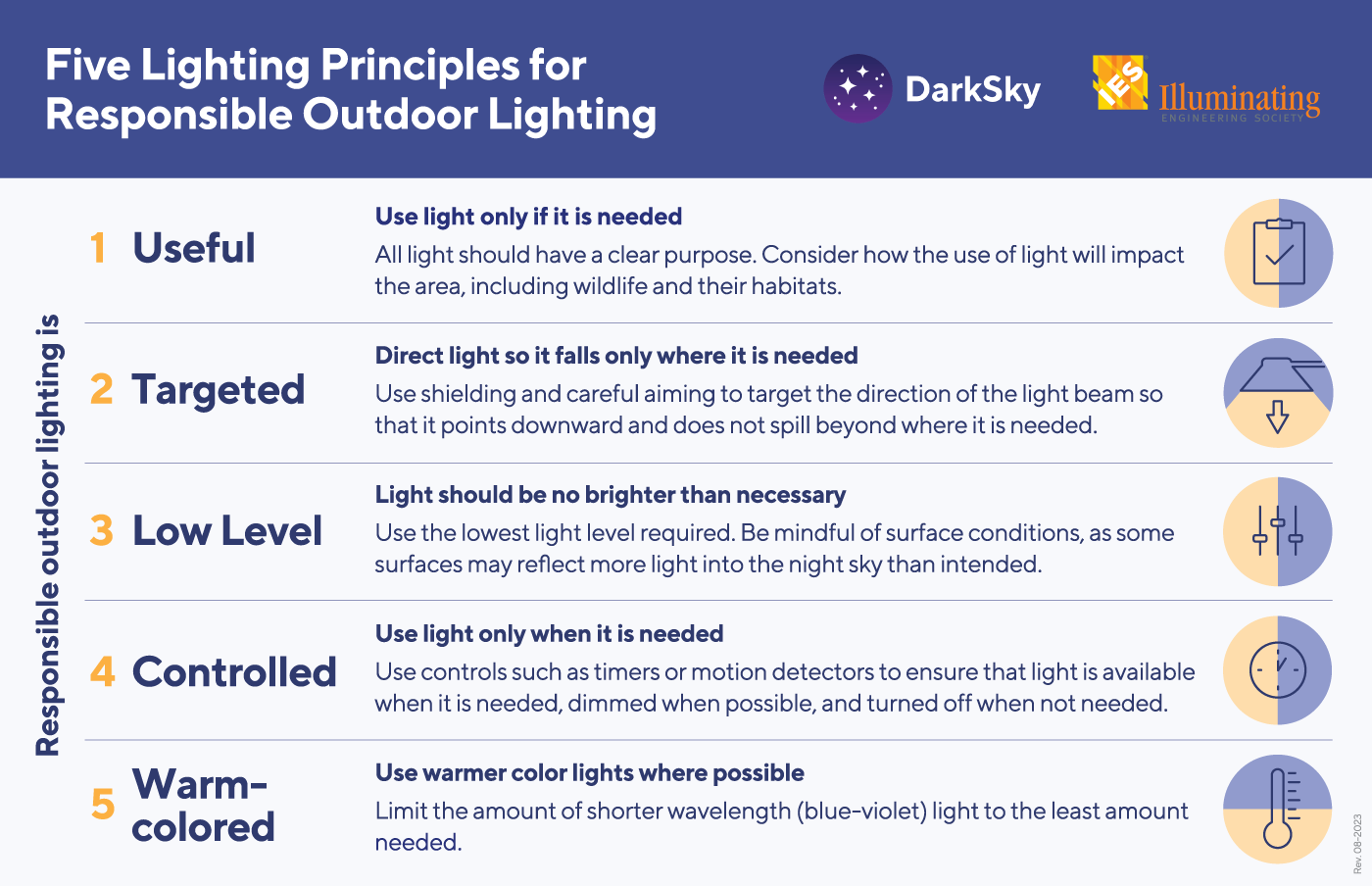
Addressing light pollution is a critical step towards achieving sustainable well-being. Fortunately, solutions are readily available and can be implemented at various levels (picture 3):
Responsible Lighting Principles. Five quite simple principles of responsible outdoor lighting can have a significant impact on light pollution mitigation and they are: light should be used where it is needed, only when it is needed, only the amount necessary, only for the task needed, and only warm color temperatures [17]. This approach emphasizes efficiency, purpose, and minimizing skyglow.
Policy and Regulation. Governments and local authorities have a crucial role to play in enacting and enforcing “dark sky” ordinances and lighting regulations. These policies can promote the use of fully shielded fixtures that direct light downwards, limit upward light spill, and specify appropriate light levels and color temperatures for different zones [18, 19].
Technological Solutions. Light pollution mitigation is inseparably connected to innovations in lighting technologies. Smart lighting systems can incorporate dimming capabilities, motion sensors, and adaptive controls to ensure light is only used when and where necessary. The careful selection of LED lights with warmer color temperatures (e.g., 2700K or less) can significantly reduce blue light emissions, which are particularly disruptive to wildlife and human circadian rhythms.
Individual Actions. Every individual can contribute to reducing light pollution. Simple steps include using warm-colored bulbs in outdoor fixtures, ensuring outdoor lights are shielded and directed downwards, closing blinds and curtains at night to prevent light spill, and supporting initiatives that promote “dark sky” preservation.
Picture 3. Five lighting principles for responsible outdoor lighting [17].
Conclusion: A Brighter Future Through Darker Nights
Light pollution is more than just a loss of dark skies. It affects wildlife, disrupts ecosystems, and can even harm human health. By learning more about these impacts, we can see why this issue deserves more attention.
The good news is that light pollution is something we can reduce. Smarter lighting choices, better policies, and new technologies can help us use light only where and when it is truly needed. By protecting the natural darkness of night, we help protect animals, support healthy ecosystems, improve our own well-being, and restore our connection to the stars.
A better future depends not on making the night brighter, but on learning to value the darkness.
References
European Commission, Joint Research Centre, Ehrlich, D., Kemper, T., Uhl, J. H., Marí Rivero, I., Florio, P., Pesaresi, M., Melchiorri, M., Politis, P., Maffenini, L., Schiavina, M., Tommasi, P., Carioli, A., Krasnodębska, K. (2024). Atlas of the Human Planet. Publications Office of the European Union, Luxembourg. https://data.europa.eu/doi/10.2760/808886
Li, T., Wang, Z., Kyba, C. C. M., Román, M. O., Seto, K. C., Yang, Y., Qiu, S., Kuester, T., Fragkias, M., Chen, X., Meyer, T. H., Rittenhouse, C. D., Tai, X., Cullerton, M., Hong, F., Grinstead, A., Song, K., Suh, J. W., Yang, X., Kalb, V. L., Zhu, Z. (2026). Satellite imagery reveals increasing volatility in human night-time activity. Nature, 652(8109), 379–386. https://doi.org/10.1038/s41586-026-10260-w
So, Chu-wing & Pun, Chun Shing & Liu, Shengjie & Cheung, Sze Leung & Hui, Ho & Blumenthal, Kelly & Walker, Constance. (2025). Natural experiments from Earth Hour reveal urban night sky being drastically lit up by few decorative buildings. Scientific Reports, 15. https://doi.org/10.1038/s41598-025-05279-4.
Johnston, A. S. A., Kim, J., & Harris, J. A. (2025). Widespread influence of artificial light at night on ecosystem metabolism. Nature climate change, 15(12), 1371–1377. https://doi.org/10.1038/s41558-025-02481-0
Prokić, M.D., Gavrilović, B. R., Gavrić-Čampar, J. P., Despotović, S. G., Radovanović, T. B., Petrović, T. G. (2026). Amphibians under artificial light at night: Current knowledge, conservation challenges and future directions. Biological Conservation, 315(111729), ISSN 0006-3207. https://doi.org/10.1016/j.biocon.2026.111729
Wang, L., Meng, L., Richardson, A., Hölker, F., Li, H., Mao, J., Longcore, T., Xia, J., She, D. (2025). Artificial light at night outweighs temperature in lengthening urban growing seasons. Nature Cities, 2(6), 506–517. https://doi.org/10.1038/s44284-025-00258-2
Johnston, A. S. A., Kim, J., Harris, J. A. (2025). Widespread influence of artificial light at night on ecosystem metabolism. Nature climate change, 15(12), 1371–1377. https://doi.org/10.1038/s41558-025-02481-0
Johnston, A.S.A., Kim, J., Harris, J.A. (2025). Widespread influence of artificial light at night on ecosystem metabolism. Nature Climate Change, 15(12), 1371–1377. https://doi.org/10.1038/s41558-025-02481-0
Thomas, D.W., Motta, M.E., Barentine, J. (2025). Only shine the light where and when it is needed – the impact of light pollution. Future Healthcare Journal, 12. https://doi.org/10.1016/j.fhj.2025.100470
Christensen, T., Røysamb, A., Bayr, U., Bui, D., Helgadottir, G., Johansen, N., Klein, J., Louwe, M., Mork, R., Noh, K., Reinhardt, S., Robsahm, T., Roll, K., Steifetten, Ø., Strömberg, P., Østenstad, G., Zaikina, V. (2026). Light pollution: environmental and health impacts at high latitudes. Photochemical & Photobiological Sciences, 25. https://doi.org/10.1007/s43630-025-00841-5
Burns, A.C., Windred, D.P., Rutter, M.K., Olivier, P., Vetter, C., Saxena, R., Lane, J., Phillips, A., Cain, S. (2023). Day and night light exposure are associated with psychiatric disorders: an objective light study in >85,000 people. Nature Mental Health, 1, 853–862. https://doi.org/10.1038/s44220-023-00135-8
Pothukuchi, K. (2025). Mitigating urban light pollution: A review of municipal regulations and implications for planners. Journal of Urban Affairs, 47(5), 1663–1690. https://doi.org/10.1080/07352166.2023.2247506
Yakushina, Y. (2025). Light pollution regulations and where to find them. Journal of Environmental Management, 373(123757), ISSN 0301-4797. https://doi.org/10.1016/j.jenvman.2024.123757.
Falchi, F., Cinzano, P., Duriscoe, D., Kyba, C. C. M., Elvidge, C. D., Baugh, K., et al. (2016). The new world atlas of artificial night sky brightness. Sci. Adv. 2:e1600377. doi: 10.1126/sciadv.1600377
Author: Gaila Tulusiene, Institute of Environmental Engineering, KTU
DISCLAIMER: Co-funded by the European Union. Views and opinions expressed are however those of the author(s) only and do not necessarily reflect those of the European Union or Fundacja Rozwoju Systemu Edukacji (FRSE). Neither the European Union nor FRSE can be held responsible for them.
GET IN TOUCH
We love to hear from you
For information about data privacy, please check the privacy policy.
Thank you! Your submission has been received!
Oops! Something went wrong while submitting the form.