
Menu
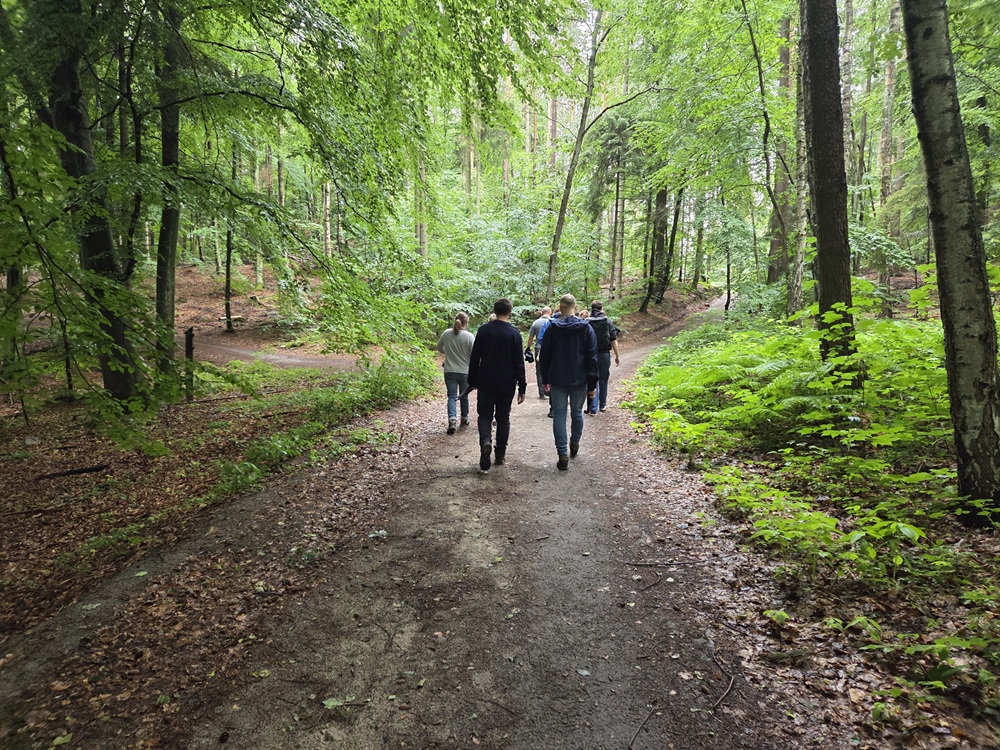
Many of us today work at a desk, in front of a computer. Business meetings are similar – a conference room, a presentation, a short coffee break, and a few conversations at the tables. However, we increasingly ask ourselves whether this is truly the best environment for exchanging ideas and building relationships. Research suggests that movement can support creative thinking, contact with nature helps us unwind, and good relationships are important factors influencing our health and well-being (Oppezzo & Schwartz, 2014; Bratman et al., 2015; White et al., 2019; Holt-Lunstad et al., 2010) .
What if business meetings were moved from the conference room to the forest?
WalkieTalkieClub is based on this idea – an initiative that combines networking, walking, and contact with nature. Its value, however, lies not only in offering a more interesting alternative to traditional business meetings. WalkieTalkieClub shows that personal, professional, and planetary well-being can come together in one practice: walking and talking together.
An idea that was born during a walk
The story of WalkieTalkieClub began exactly where meetings take place today – in motion and in nature.
As project initiator Marcin Wesołowski explains: "The idea was born during a forest walk with a friend, Łukasz Brandt. Walking through the Tricity Landscape Park and talking about business, we came to the conclusion that once again, exercise and fresh air allowed us to solve difficult problems."
This experience became the starting point for the question of whether a similar format would work not only for two-person conversations, but also for larger groups. The Tricity startup community is growing, with new events and collaborative spaces emerging. WalkieTalkieClub offered something different: networking without a stage, room, or formal atmosphere.
As the organizer says: "We started wondering how this format would work for a slightly larger group, as a networking opportunity. A startup community is currently emerging in the Tricity area; a large WhatsApp group has been established, the Gdańsk Bay Tech ecosystem is developing, and more and more business events are taking place. I thought I'd offer this community a new format for meetings. It caught on."
Why does walking help you think?
What the creators of WalkieTalkieClub intuitively discovered is also confirmed by research. Oppezzo and Schwartz from Stanford University showed that walking can promote creative thinking regardless whether done outdoors or indoors (Oppezzo & Schwartz, 2014). This suggests that movement itself can help you see a problem from a different perspective.
Marcin describes it similarly: "First of all, walking stimulates circulation, and circulation stimulates our brain. We think more clearly, and tension and stress subside."
Walking isn't just a backdrop for conversation. It's an active element. When your body moves, it's easier to see a problem from a different perspective. This is especially important in a professional context, because discussing ideas, decisions, and challenges requires not only concentration but also freedom and openness.
Relationships built side by side
Walking also changes the dynamic of the conversation. In classic networking, we often stand facing each other, looking into each other's eyes, and trying to make a good impression. Walking is different. We walk side by side, at a similar pace, looking in the same direction.
The organizer describes it this way: "Secondly, we walk in unison, in complete synchronization, looking straight ahead. We don't look each other in the eye, so honesty emerges. Shy people have it much easier. No one dominates, and this promotes fruitful networking."
This is an important element of professional well-being. A good collaborative environment is based not only on efficiency but also on psychological safety - the feeling that you can speak up, ask questions, share concerns, and present ideas without fear of judgment. Amy Edmondson has shown that psychological safety promotes learning and better cooperation in teams (Edmondson, 1999).
What does a meeting look like?
The format of WalkieTalkieClub is simple. Participants meet at a specific location, usually at the entrance to the forest. The walk lasts about an hour. At the beginning, everyone briefly introduces themselves: what they do for a living and what challenge they're bringing.
As Marcin explains: "The meetings are most often attended by people planning or developing their own business concepts. There are also experts from a wide variety of industries."
You can change conversation partners during the walk, but there's no rigid script or coercion. "A networking walk must feel natural and unforced."
This naturalness is one of the initiative's greatest strengths. In a world where many business events are highly planned and results-oriented, WalkieTalkieClub leaves room for chance, intuition, and ordinary human conversation.
Personal Well-Being: Movement, Breathing, and a Sense of Freedom
WalkieTalkieClub supports professional well-being, but it starts with something more fundamental: your body. With exercise, fresh air, and a change of scenery.
What WalkieTalkieClub participants describe aligns well with research findings. Spending time in nature promotes better well-being, and people who do it regularly are more likely to rate their health and well-being as better (White et al., 2019). Even a relatively short walk in a natural setting can help clear the mind and reduce rumination, or the persistent recurrence of negative thoughts (Bratman et al., 2015).
This doesn't mean that every walk will solve mental or professional problems. But nature and exercise can create conditions that foster greater peace, improved well-being, and more open conversations. Marcin says: "What everyone notices is the ease of establishing contacts and openness of conversations. The previously mentioned aspects of outdoor activity certainly have a significant impact on this."
He adds: "A walk is a completely different experience than face-to-face networking after a main event, such as a lecture. A different environment, a relaxed atmosphere, and shared conversations as the main goal of the event certainly help."
.jpg)
A common mindset and quick flow
In WalkieTalkieClub it is not only about where the meeting takes place, but also about who attends. These are people interested in business, developing ideas, and exchanging experiences, but also those who choose to spend their time actively.
The organizer notes: "I think a shared mindset is also very important. What unites all participants isn't just their interest in business. It's also their shared passion for spending time actively, on the move, in the forest. This certainly helps them quickly get into the flow."
Walking is not only an opportunity for exercise but also for meeting other people, which is important for our well-being. As the research shows, social relationships are a key factor influencing health, and people with stronger connections live longer on average than those who are more isolated (Holt-Lunstad et al., 2010).
Planetary Well-Being: Bringing Business Back to Nature
In WalkieTalkieClub, contact with nature isn't just an aesthetic addition. The forest isn't just a pretty backdrop for a meeting. It's part of the concept.
When asked if contact with nature and walking itself were important from the beginning, Marcin replies: "Yes, because we believe that for humans, the forest is still instinctively the most natural environment in which to live. Apartments, streets, and office buildings are environments we've only been in for a relatively short time, considering human history. In my opinion, everyone feels much more at ease, confident, and simply better in a forest, on a beach, or in a meadow."
This leads to the third dimension of well-being: planetary well-being, which doesn't not have to mean only large-scale climate action. It's also a question of how we design our daily practices, work, and relationships. Is nature separate from our professional lives, or can it become a natural part of them?
WalkieTalkieClub proposes a small but significant change. Instead of organizing another event in a closed space, it utilizes what already exists: paths, forest, movement, and conversation and doesn't require a hall or catering. Is also reminds us that more sustainable practices can start with simple decisions.
The organizer's question resonates most strongly here: "Why shouldn't such an important aspect of life as business take place, at least partially, in such a favorable environment?"
More than networking
Although the initiative has only been in existence for a few months, it clearly responds to a real need.
As Marcin says, "The initiative has only been running for three months. We've already held eight walks, and each one has had an average of about a dozen people. Most of them are new faces, but there are also repeat participants, and almost every participant has expressed a desire to come back."
The most important outcomes, however, don't always happen during the walk itself. Sometimes they emerge later: in a subsequent conversation, decision, or collaboration.
"However, there have already been many contacts that resulted in follow-up after the walk. I also know of at least a few important business decisions that were made as a result of conversations during the WalkieTalkieClub walk."
This shows that the value of networking isn't necessarily in the number of business cards handed out, but in the quality of the conversations that lead to further action. Walking helps you not only get to know others but also hear yourself.
As the organizer encourages: "It's worth coming and comparing your ideas with others, because sometimes even words spoken aloud can shape your thoughts. You can always count on honest opinions and advice from your interlocutors."
Keep going, even when it rains
WalkieTalkieClub plans to continue its walks year-round, not just when the weather is perfect for perfect photos and easy access to the outdoors.
"We plan to continue this year-round! We try to plan one walk a week. The last one took place in the pouring rain, because just like in business, sometimes the sun shines, sometimes it rains and blows, and we have to keep going. Snow won't stop us either."
Sometimes you just need to go for a walk
For now, WalkieTalkieClub operates in the Tricity area, but the organizers hope that over time similar walks will also take place in other cities.
As Marcin says: "Currently we are walking in the Tricity, but I really hope that one day we will be contacted by people who want to co-create WalkieTalkieClub with us also in other cities. What is certain is that in the Tricity area, WalkieTalkieClub will continue its walk.”
WalkieTalkieClub shows that sometimes the best ideas are surprisingly simple. Instead of another meeting in the conference room – take a walk. Instead of a short conversation over coffee – an hour of walking together. That's enough to see your challenges from a different perspective, meet new people, and spend time closer to nature.
References
Bratman, G. N., Hamilton, J. P., Hahn, K. S., Daily, G. C., & Gross, J. J. (2015). Nature experience reduces rumination and subgenual prefrontal cortex activation. Proceedings of the National Academy of Sciences, 112(28), 8567–8572.
https://doi.org/10.1073/pnas.1510459112
Edmondson, A. (1999). Psychological safety and learning behavior at work teams. Administrative Science Quarterly, 44(2), 350–383.
https://doi.org/10.2307/2666999
Holt-Lunstad, J., Smith, T. B., & Layton, J. B. (2010). Social relationships and mortality risk : A meta- analytic review. PLOS Medicine, 7(7), e1000316.
https://doi.org/10.1371/journal.pmed.1000316
Oppezzo, M., & Schwartz, D. L. (2014). Give your ideas some legs : The positive effect of walking on creative thinking. Journal of Experimental Psychology: Learning, Memory, and Cognition, 40(4), 1142–1152.
https://doi.org/10.1037/a0036577
White, M. P., Alcock, I., Grellier, J., Wheeler, B. W., Hartig, T., Warber, S. L., Bone, A., Depledge, M. H., & Fleming, L. E. (2019). Spending at at least 120 minutes a week in nature is associated with good health and well-being. Scientific Reports, 9, 7730. https://doi.org/10.1038/s41598-019-44097-3
Author: Malgorzata Zieba, based on the interview with Marcin Wesołowski and listed resources
Publication Date: 24.07.2026

Marcin Wesołowski is a graduate of the Gdańsk University of Technology and an entrepreneur who has been developing technology businesses for 20 years. He is currently involved in new projects, consulting, and organizing WalkieTalkieClub – regular networking walks for founders. LinkedIn profile: https://www.linkedin.com/in/mwesolowski-sn/
WalkieTalkieClub https://walkietalkie.club/


DISCLAIMER:
Co-funded by the European Union. Views and opinions expressed are however those of the author(s) only and do not necessarily reflect those of the European Union or Fundacja Rozwoju Systemu Edukacji (FRSE). Neither the European Union nor FRSE can be held responsible for them.
We love to hear from you
For information about data privacy, please check the privacy policy.