
Menu
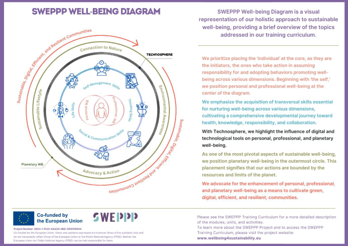
As the SWEPPP project approaches its conclusion, it is a good opportunity to reflect on one of its key achievements – the development, testing, and refinement of the Sustainable Wellbeing e-learning course.
What started as an ambition to create accessible learning resources on personal, professional, and planetary well-being gradually evolved into a comprehensive learning package that has reached students, educators, trainers, and practitioners across different countries and learning environments.
Creating Learning Resources for Diverse Learners
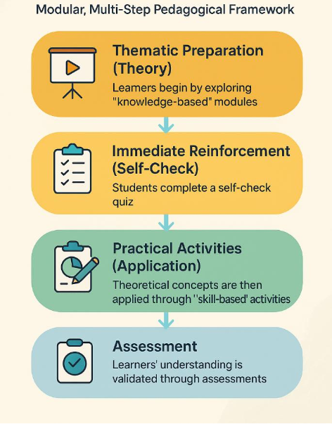
From the beginning, the project consortium aimed to develop learning materials that would be flexible enough to meet the needs of different target groups while maintaining a consistent educational approach. SWEPPP has developed an open-access e-learning course “Sustainable Wellbeing: Harmonizing Personal, Professional and Planetary Dimensions” with two complementary learning pathways [1].
The first pathway is designed for self-directed learning (1 ECTS course). It allows learners to explore sustainable wellbeing topics independently, at their own pace, and according to their personal interests and learning needs. The second pathway (2 ECTS course) supports learning by leading of teacher and facilitator [2]. In addition to the e-learning materials, the project developed a dedicated tutorial for educators, trainers, and facilitators, enabling the modules to be integrated into university courses, workshops, professional development programmes, and non-formal education activities.
Building on Previous Experience
The development of the SWEPPP modules did not start from scratch. The consortium was able to build on previous experiences in digital learning and micro-module development, including knowledge gained through earlier KTU micro-module initiatives.
This experience helped shape the structure of the modules, the balance between theoretical and practical content, and the design of learning activities. Particular attention was paid to creating materials that could be easily adapted by different institutions and transferred into existing learning management systems.
As a result, the final learning package offers flexibility both for independent learners (1ECTS Mooc) and for institutions wishing to integrate sustainable wellbeing topics into their own modules (2 ECTS Moodle course and open access material plus Tutorial for teachers).
Learning Through Piloting
One of the most valuable stages of the project was the piloting process.
The modules were tested with different target groups, including university students, educators, trainers, and other stakeholders interested in sustainability and wellbeing. This provided an opportunity to evaluate not only the content itself but also the learning experience, usability, and relevance of the materials.
Participants highlighted the practical nature of the course and the possibility to apply many of the concepts directly to their daily lives.
As one participant noted:
"The most valuable thing was that some of the course learnings you can adapt to your own life."
Others appreciated the focus on personal wellbeing, mindfulness, and self-reflection.
"I liked the reminder about personal well-being. This is an aspect that is often forgotten."
"To slow down in daily life, pay attention to details and live in the present moment."
Many learners also valued the course's holistic perspective, which connected individual wellbeing with broader environmental and societal challenges.
"The most valuable thing I've learned is the interconnectedness of various aspects of well-being, from digital mindfulness and emotional intelligence to ecological resilience and planetary health."
Nature-based wellbeing activities attracted particular interest among participants.
"The most valuable thing is how contact with nature can have a positive effect on well-being. Walking in the forest was an interesting experience."
Continuous Improvement Through Feedback
Piloting was not simply a validation exercise. Feedback collected throughout the process became an important source of inspiration for improving the modules. Participants appreciated the variety of learning materials, including presentations, videos, practical exercises, reflective journals, group discussions, and case studies.
"The diary was a good form of learning."
"I am happy that there were presentations and videos; this diversity helped to capture my attention."
At the same time, learners also provided constructive suggestions. Some expressed interest in more interactive activities, additional outdoor learning experiences, and deeper exploration of selected topics such as psychology, emotional intelligence, and personal development.
Others suggested creating stronger links between modules and incorporating more advanced content for learners who already possessed foundational knowledge.
These insights were carefully considered by the consortium and contributed to further refinement of the learning materials. Based on participant feedback, the modules were updated to improve the flow between learning units, strengthen practical and reflective activities, and enhance the overall learning experience.
Interest Beyond Academia
Although the primary target group of the project consisted of higher education institutions, interest in the learning materials quickly expanded beyond universities. The topic of sustainable wellbeing resonated strongly with practitioners, trainers, community organisations, and professionals working in different sectors. This demonstrated that the project outcomes have relevance far beyond formal education.
As a result, SWEPPP resources and experiences have been shared through conferences, workshops, stakeholder meetings, and various dissemination events, organised in Lithuania, Poland, Finland and Germany, helping to raise awareness about the importance of connecting personal, professional, and planetary wellbeing.
Looking Ahead
The project has demonstrated that sustainable wellbeing is a topic that resonates with diverse audiences. Learners value practical tools, opportunities for reflection, and approaches that help them connect their personal choices with wider social and environmental challenges.
As the SWEPPP project comes to an end, we hope that these learning resources will continue to support educators, learners, and organisations in fostering sustainable wellbeing for years to come.
The project seeks to ensure that its results are widely used and contribute to wellbeing from a sustainability perspective. Therefore, all materials developed are openly accessible as separate documents, Moodle and MOOC courses, and can also be adapted to specific needs.
There is a possibility to receive a backup file of the Moodle course, which can be integrated into the institutional online learning platform. The course can then be tailored to meet teachers’ needs, institutional requirements, as well as the competences that students already possess or aim to develop.
Requests to receive the backup file should be sent via email: projectsweppp@gmail.com
More information: www.wellbeing4sustainability.eu/#courses
Notes:
[1] 1-ECTS self-paced course for independent learners: (link)
[2] 2-ECTS guided course (link) for integration into study programmes, supported by a Tutorial for teachers and facilitators (link)
--
Authors: Daina Kliaugaitė, Kaunas University of Technology; Inga Gurauskienė, Kaunas University of Technology
Publication Date: 26.06.2026


DISCLAIMER:
Co-funded by the European Union. Views and opinions expressed are however those of the author(s) only and do not necessarily reflect those of the European Union or Fundacja Rozwoju Systemu Edukacji (FRSE). Neither the European Union nor FRSE can be held responsible for them.
We love to hear from you
For information about data privacy, please check the privacy policy.