
Menu
#Sleep #Recovery #Procrastination #HealthyMind #Wellness
Procrastination is the act of delaying the completion of a task despite being aware of its negative consequences. Procrastination most often concerns things that are laborious, difficult, anxiety-provoking, or that we simply do not enjoy [1]. But what is revenge bedtime procrastination [RBP]? Sleep is generally associated with something pleasant, yet RBP is becoming an increasingly recognized phenomenon. RBP is a term used to describe a behavior that meets three criteria:
UCE Research and the ePsycholodzy.pl portal conducted a nationwide study involving 829 participants aged 18–35. The study revealed that 33.05% of people in this age group sleep less than 6 hours per night. Specifically, 2.17% of respondents sleep around 4 hours, 8.32% sleep from 4 to 5 hours, and 22.56% sleep from 5 to 6 hours. The recommended amount of sleep for this age group is from 7 to 9 hours, which means that a significant proportion of these people suffer from chronic sleep deprivation [3]. However, this problem is not limited to Polish society. Research by Hafner et al. (2017) indicates a similar trend in the United States, the United Kingdom, Japan, Germany, and Canada. Sleep deprivation negatively affects our health, social relationships, and overall wellbeing, and also has a significant impact on the economy. Chronic sleep deprivation increases the risk of premature death. A chronically sleep-deprived employee is less productive and more likely to be absent from work due to sick leave. Meanwhile, young people who regularly experience sleep deprivation can significantly hinder their development [4].
What factors influence RBP?
So far, no single main factor causing RBP has been identified. It is a relatively new phenomenon that is still being studied. The underlying causes may be multidimensional. High levels of stress and a lack of time during the day may result in a desire to spend some time on entertainment or simply find some time for oneself. Problems with time management and difficulties in transitioning from a state of activity to a state of rest may also contribute to RBP. Spending time in front of computer or smartphone screens, which emit blue light, as well as watching “just one more video” or “just one more episode” of a TV series, can maintain a state of alertness and delay the natural need for sleep. In addition, chronotype may play a role: people who are more active in the evening may have a circadian rhythm that does not align with the demands of working hours or other daily responsibilities [2].
It is worth mentioning that sleep is very often referred to as a silent healer. During sleep, processes take place that play an important role in maintaining our physical and mental health. During sleep, among other:
Together, these processes support physical and mental health as well as overall wellbeing.
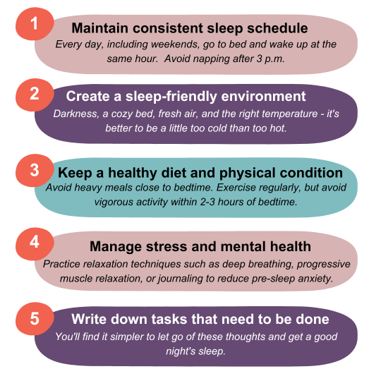
Thus, how can we overcome RBP and take advantage of the processes that occur during the night? The best approach is to take care of healthy sleep hygiene. Figure 1 presents five simple rules that may help prevent sleep procrastination.
Want to learn more? Visit our website and discover wide range of materials 👇
https://www.wellbeing4sustainability.eu/
--
Author: Magdalena Fabjanowicz, Gdansk University of Technology, Poland
Publication Date: 28.08.2026
--
References:
[1] Sirois F.M. (2023) Procrastination and Stress: A Conceptual Review of Why Context Matters. International Journal of Environmental Research and Public Health, 20(6), p.5031. DOI: 10.3390/ijerph20065031
[2] Suni E. (2025) Revenge Bedtime Procrastination. Sleep Foundation, updated 15 July. Available at: https://www.sleepfoundation.org/sleep-hygiene/revenge-bedtime-procrastination (Accessed: 22 August 2026).
[3] Piotrowska M. (2026) Młodzi Polacy za mało śpią. Straty gospodarki liczone są w miliardach. Interia Biznes. Available at: https://biznes.interia.pl/gospodarka/news-mlodzi-polacy-za-malo-spia-straty-gospodarki-liczone-sa-w-mi,nId,23508259 (Accessed: 22 August 2026).
[4] Hafner M., Troxel W.M., Stepanek M., Taylor J., Stolk C.V. (2017) 0803 WHY SLEEP MATTERS: THE MACROECONOMIC COSTS OF INSUFFICIENT SLEEP, Sleep, 40 p.A297. DOI: 10.1093/sleepj/zsx050.802
[5] Cramer, S., Espie, C. (2016) Waking up to the health benefits of sleep. Royal Society for Public Health, University of Oxford
Image source: Unsplash, photo taken by Annie Spratt


DISCLAIMER:
Co-funded by the European Union. Views and opinions expressed are however those of the author(s) only and do not necessarily reflect those of the European Union or Fundacja Rozwoju Systemu Edukacji (FRSE). Neither the European Union nor FRSE can be held responsible for them.
We love to hear from you
For information about data privacy, please check the privacy policy.