
Menu
From the very beginning of the SWEPPP project, we have emphasized a simple but powerful idea: well-being starts with oneself and ripples outward - towards our families, friends, communities, and the professional environments in which we interact every day.
This interconnected understanding of well-being becomes even more critical in sectors where working conditions are particularly demanding. The maritime industry is a clear example. People working at sea often face long periods of isolation, limited social interaction, high responsibility, and continuous operational pressure.
Research increasingly highlights the urgency of this topic. The International Maritime Organization (IMO) identifies fatigue as a critical risk factor affecting seafarers’ performance and safety, often linked to demanding working conditions and extended periods on board [1]. In addition, IMO guidance on crew welfare and mental wellness highlights the psychological strain associated with prolonged time at sea and limited social interaction [2]. The International Labour Organization, through the Maritime Labour Convention, further emphasizes the importance of regulating working and living conditions to protect seafarers’ well-being [3].
At the same time, the maritime industry is undergoing an important shift. Beyond traditional safety checklists and technical compliance, there is growing recognition of well-being-related and psychosocial risks as integral to overall safety. Recent developments led by the International Maritime Organization show that factors such as fatigue, mental health, and even harassment and bullying are increasingly being addressed within safety management frameworks [4].
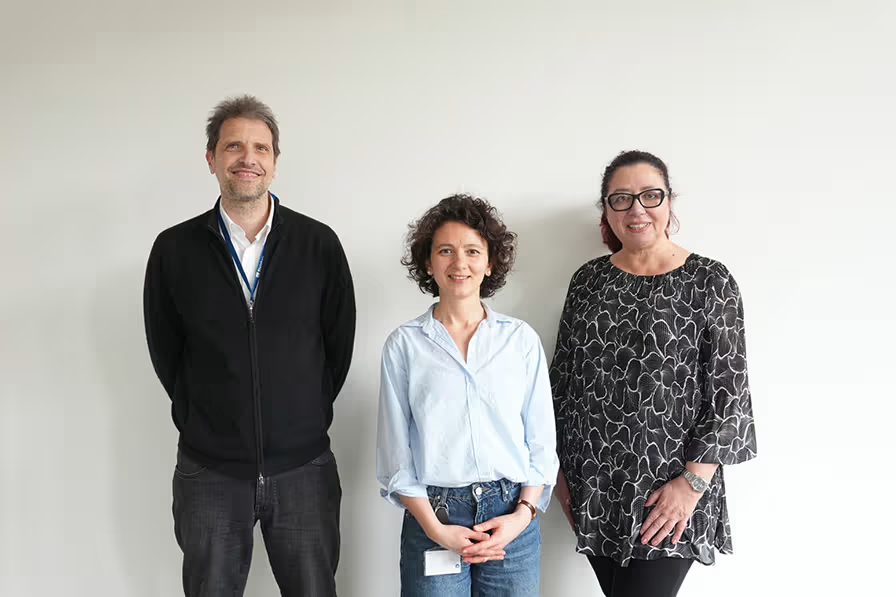
In line with these developments, the current hosting of Prof. Andrea Russo at the Steinbeis School of Sustainable Innovation and Transformation (SIT) offers a timely opportunity to explore these topics further. Prof. Russo, from the University of Split, whose work bridges psychology and public health, focuses on psychological well-being in high-risk and high-responsibility sectors. Together, the SIT team and Prof. Russo are working on the development of a new training offer addressing human factor risk management in the maritime industry. This initiative aims to support organizations in recognizing early warning signs, strengthening communication, and fostering healthier, more resilient work environments on board.
In this blog, we share a short interview with Prof. Russo, highlighting key insights from her work and our ongoing collaboration.
Key Takeaways from the Interview
Before diving into the full interview, here are some of the main insights:
Well-being is directly linked to safety and performance: Psychological well-being is not separate from operational risk - it directly affects communication, decision-making, and the ability to respond to problems in time.
Risks often start silently: Early signs such as withdrawal, reduced communication, or emotional disconnection are often overlooked, yet they are critical indicators of deeper issues.
Maritime work amplifies human challenges: Isolation, fatigue, hierarchical structures, and multicultural crews create a unique combination of pressures that require tailored approaches.
Psychological safety is essential for risk prevention: When employees do not feel safe to speak up, risks remain hidden and can escalate into serious incidents.
Harassment and misconduct are now recognized as safety risks: Modern frameworks increasingly include bullying, harassment, and abuse of power as part of risk management and compliance.
Organizations need a cultural shift - not just procedures: True safety and resilience require trust, communication, and leadership maturity - not only technical compliance.
Early intervention makes the difference: Creating environments where people feel able to speak up early can prevent conflict, breakdown, and accidents.
–
We explored these themes further in our conversation with Prof. Andrea Russo, whom we thank for her valuable insights. You can read the full interview below.
–
References
[1] International Maritime Organization (IMO) (n.d.), Fatigue. Available at: https://www.imo.org/en/ourwork/humanelement/pages/fatigue.aspx (Accessed: 16.04.2026)
[2] International Maritime Organization (IMO) (2021), Crew welfare management and mental wellness (2nd ed.). Available at: https://wwwcdn.imo.org/localresources/en/MediaCentre/HotTopics/Documents/2021_Crew%20Welfare_Management_and%20Mental_Wellness_2nd-ed-web_2.pdf (Accessed: 16.04.2026)
[3] International Labour Organization (ILO) (2006), Maritime Labour Convention (MLC), 2006. Available at: https://www.ilo.org/international-labour-standards/maritime-labour-convention-2006 (Accessed: 16.04.2026)
[4] International Maritime Organization (2025), Seafarer fatigue, work hours and harassment at sea. Available at: https://www.imo.org/en/mediacentre/pressbriefings/pages/seafarer-fatigue-work-hours-harassment.aspx (Accessed: 16.04.2026)
Author: Ela Kurtcu - EMG / SIT
Interview conducted in Berlin on 14.04.2026.
Publication Date: 17.04.2026
Full Interview
1. Could you briefly tell us about your professional journey and explain what led you to focus on psychological well-being, especially in high-risk sectors such as maritime?
My professional journey developed through psychology, pedagogy, and public health, but from the very beginning, what interested me most were people: how they experience pressure, how they behave when things become difficult, what motivates them, what shuts them down, and how a work environment can bring out their best or gradually wear them down.
Very early on, I realized that many problems in the workplace do not appear all at once. Before there is open conflict, a mistake, withdrawal, or damaged relationships, there are usually already signs that something is not right. People often do not express themselves directly. Sometimes they remain silent, sometimes they withdraw, sometimes they work mechanically, and sometimes they lose their sense of connection, meaning, or trust. And very often, those quiet signals are the most important ones.
That is why I have always been interested not only in how to help an individual, but also in how to build an environment in which people can function better, one with more clarity, more responsibility, stronger human connection, and more space to recognize a problem while there is still time to act.
The maritime sector became especially important to me because all of these elements are intensified there. People work and live in the same space, they are separated from their families for long periods, they operate within clear hierarchies, carry major responsibility, and work under constant operational pressure. In such an environment, it is not only a question of what a person knows how to do, but also how they cope with stress, how much trust they have in others, whether they feel part of a team, and whether they feel seen and understood in time.
That is why, for me, well-being in the maritime industry has never been a secondary issue. It is connected to the way people work, communicate, make decisions, ask for help, take responsibility, and remain professionally stable even under very demanding conditions.
2. From your perspective, how is employee well-being connected to risk management and the prevention of misconduct in shipping companies?
I see that connection as very direct. When people work in an environment where they are chronically exhausted, under pressure, emotionally overloaded, or feel they cannot speak openly, what weakens is exactly what an organization needs most, timely recognition of problems, good communication, and responsible response.
In other words, a person who does not feel safe, respected, and trusted will find it harder to say that something is wrong. Harder to admit they are struggling. Harder to warn others about a problem. And when people remain silent, risks do not disappear. They simply become less visible.
The same is true for inappropriate conduct. Harassment, bullying, humiliation, or abuse of power do not develop only because of one individual. They also develop because of an atmosphere in which others do not react, where boundaries are unclear, and where people do not believe they will be protected or taken seriously.
That is why I do not see employee well-being as something separate from business or safety. It is closely linked to company culture, leadership quality, the way problems are addressed, and the extent to which an organization is able to create an environment where people do not work only because they have to, but because they feel responsibility, belonging, and trust that they will be heard when it matters most.
3. In your view, what are some of the most specific psychological and well-being challenges faced by employees in the maritime and shipping sector today?
The maritime sector involves a very specific combination of pressures. There is long separation from family, living and working in a confined space, lack of privacy, fatigue, disrupted sleep patterns, high responsibility, constant operational readiness, and often complex relationships within both hierarchy and multicultural teams.
But I would say that one of the biggest challenges today is not stress alone, but the way it shows itself. People do not always show strain openly. Sometimes they withdraw. Sometimes they become quiet. Sometimes they lose patience. Sometimes they avoid conversation. Sometimes they do everything that is expected of them, but without real connection to the team and without inner stability.
These are situations that may look “under control” from the outside, while in reality they already show that a person or a team is no longer functioning as they should. In such an environment, it is very important to understand that the problem does not begin only when an incident happens. It often begins much earlier, when relationships begin to erode, when trust disappears, when people start feeling alone, unseen, and unsafe to speak.
That is why today it is not enough to observe only formal job performance. It is also necessary to better understand what is happening beneath the surface, between people, in communication, in the team, and in a person’s sense of inner stability.
4. Why do you believe it is especially important for the maritime industry to address employee well-being seriously at this moment in time?
Because it is no longer enough to rely only on procedures, technical standards, and the expectation that people will simply endure. Today’s working environment, and maritime is no exception, requires greater maturity in the way people are led.
Today, people recognize much more clearly the difference between an organization that only formally meets its obligations and one that truly understands what responsibility toward people means. In maritime, that is especially important, because the consequences of poor communication, unspoken pressure, conflict, or emotional exhaustion do not remain only at an individual level. They can affect the whole team, the quality of decision-making, and the overall stability of work on board.
At the same time, the industry is facing questions of retention, trust, leadership quality, organizational culture, and reputation. It is becoming increasingly clear that a serious company is not defined only by how it manages vessels or processes, but also by how it manages relationships, how it responds when problems arise, and how early it recognizes that someone may need support, clarity, or a conversation.
That is why I believe this is the right moment. Not because well-being has become a trend, but because it has become obvious that without healthier relationships, better leadership, and greater psychological safety, there can be no truly stable and responsible organization in the long term.
5. In the training programme we are developing together, what key changes or impacts would you hope to see in organizations and employees who participate?
I would like people to come away from this programme feeling something very concrete: that they are not alone, that a problem does not have to be left until the very end, and that better communication and support are not signs of weakness, but of professional maturity.
At the organizational level, I would like to see more clarity, earlier recognition of problems, and a stronger willingness to respond before tension turns into conflict, withdrawal, resignation, or a more serious breakdown in team relationships. I would like companies to see more clearly that a support structure is not something extra, but part of stable and responsible management.
For people on board, I would like to see more trust, more openness, and greater confidence that they can approach someone in time. Not to wait until they can no longer cope, but to feel that there is space for conversation, guidance, and support while the problem is still manageable.
For me, the real impact would be if both management and seafarers could say after such a programme: this is not just training - it changes the way we look at people, leadership, and responsibility on board.
6. What would you like a shipping company to understand after this kind of collaboration?
I would like it to understand that investing in people is not something that comes after safety, but something without which true safety is incomplete. When people have more trust, clearer relationships, better support, and more space to say in time that something is wrong, the organization becomes more stable, more mature, and safer in every sense.
I would also like it to understand that a serious organization is not built only through rules and procedures, but also through the way people work with one another every day. The way people communicate, listen, respond, and lead often determines whether a problem will be addressed in time or continue to grow in silence.
And there is one more thing I find very important: people do not remember only salary and rules. They also remember how they felt in that organization. Whether they were left on their own or had the feeling that somebody truly cared. And that difference often defines trust, loyalty, and the long-term stability of the whole system.


DISCLAIMER:
Co-funded by the European Union. Views and opinions expressed are however those of the author(s) only and do not necessarily reflect those of the European Union or Fundacja Rozwoju Systemu Edukacji (FRSE). Neither the European Union nor FRSE can be held responsible for them.
We love to hear from you
For information about data privacy, please check the privacy policy.