
Menu

Thanks to the quick development of digital technology and unlimited access to the online environment, we can work, communicate, and access a range of services and entertainment throughout the day. The 24-hour support that modern services require is often given by shift workers [1]. Numerous studies have shown that shift work negatively affects employees' physical and mental well-being. Lack of adaptation to a circadian rhythm, being active at night, sleeping during the day, eating meals when the digestive system is in a latent state, occurs in more than two-thirds of shift workers [2]. The circadian rhythm disruptions can have detrimental effects on the cardiovascular system in particular. Research has indicated that shift workers had a 5% increased risk of stroke and a 23% increased risk of heart attack when compared to individuals who work regular daytime hours. After five years of exposure, the risk rises by an extra 7% every five years [1].
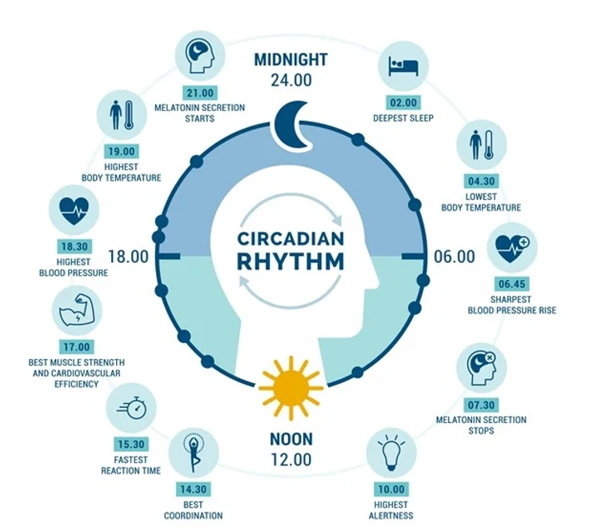
The circadian rhythm is our body's daily work pattern, encoded in our DNA, and therefore in every cell and organ in our body. It's our internal biological clock, which regulates all basic bodily processes and helps our body achieve optimal performance at specific times of day and night, as shown in Figure 1. The most significant factor regulating circadian rhythms is light. Light received by the optic nerve activates the suprachiasmatic nucleus (SCN) of the hypothalamus in the brain, which in turn triggers signals to other parts of the central nervous system (CNS), regulating hormones, body temperature, and other bodily processes [3]. Living in accordance with the circadian rhythm support:
· immunological system, boosting resistance to pathogenic illnesses;
· the organisms’ ability to recover from injury;
· brain functions, enhancing mental and emotional performance;
· metabolisms and detoxification, lowering the risk of chronic diseases [4].
Alongside the growing demand for shift work, rapid technological advancement results that people spent more and more time of their evenings in front of phone and computer screens, often delaying rest and sleep. The fast pace of modern life, constant connectivity, and everyday stress can disrupt the body’s natural circadian rhythm, contributing to insufficient sleep, persistent fatigue, and reduced overall well-being.
How to start living in accordance with the circadian rhythm?
Dr. Satchin Panda, a professor at the Salk Institute for Biological Studies in La Jolla, California, proposed six principles that may help individuals extend their healthy lifespan [5]:
1. Spent 8 hours in bed each night in order to obtain at least seven hours of restorative sleep.
2. Avoid eating at least 1 hour after waking up to let our organs to be fully awake and so properly digest food.
3. Keep time restricted eating/ intermittent fasting. Eat your meals, starting with breakfast, at consistent times each day, and consume all meals within an 8-, 10-, 11-, or 12-hour eating window during the day. It can help to maintain blood pressure, blood glucose, immune system in good condition.
4. Expose to daylight for at least 30 min a day. Exposure to natural daylight not only supports vitamin D synthesis essential for bone health, but may also help reduce the risk of depression.
5. Exercise in the afternoon for at least 30 min a day. In the afternoon, muscle performance reaches its peak, while the risk of injury decreases. Moreover, afternoon exercise is much more effective in regulating blood glucose levels than performing the same exercise in the morning, which is particularly important for the prevention and management of diabetes.
6. Avoid bright light and food 2-3 hours before bedtime. Avoiding meals 2-3 hours before sleep may support better digestion and promote gut health. While, reducing light exposure in the evening helps preserve the natural production of melatonin, thereby contributing to healthy and restorative sleep.
Want to learn more? Visit our website and discover wide range of materials 👇
https://www.wellbeing4sustainability.eu/
References:
[1] Domin, R. (2024) Praca zmianowa i zaburzony rytm dobowy: niewidoczne zagrożenie dla zdrowia. Uniwersyteckie Centrum Badań Sportowo-Medycznych. Available at: https://ucbsm.ump.edu.pl/wiadomosci-50 (Accessed: 25 May 2026)
[2] Health Labs Care (b.d.) Rytm dobowy – klucz do długiego życia. Available at: https://www.healthlabs.care/pl/blog/rytm-dobowy-klucz-do-dlugiego-zycia (Accessed: 28 May 2026)
[3] News Medical (2021) Circadian Rhythm. Available at: https://www.news-medical.net/health/Circadian-Rhythm.aspx (Accessed: 20 May 2026)
[4] Satchin Panda 2026. Circadian rhythm and health. TEDxBoston, Available at: https://www.youtube.com/watch?v=OHSvAKNvq58 (Accessed: 21 May 2026)
[5] Satchin Panda 2021. How optimizing circadian rhythms can increase healthy years. TEDxBoston, Available at: https://www.youtube.com/watch?v=fciGNBN0nKM (Accessed: 20 May 2026)
Image Source: Phot oby Ngo Ngoc Khai Huyen on Unsplash
Author: Magdalena Fabjanowicz, Gdansk University of Technology, Poland
Publication Date: 08.06.2026


DISCLAIMER:
Co-funded by the European Union. Views and opinions expressed are however those of the author(s) only and do not necessarily reflect those of the European Union or Fundacja Rozwoju Systemu Edukacji (FRSE). Neither the European Union nor FRSE can be held responsible for them.
We love to hear from you
For information about data privacy, please check the privacy policy.